


Written by AnnMarie Baines, CEO & Founder

This letter is intended for anyone who will be part of the next generation of leaders, including those who are currently leaders in their field or community. Regardless of our age or level of experience, AI will shape how we lead and learn. As an education organization, we felt it was necessary to articulate our philosophy and beliefs toward AI. We believe that productive struggle is an integral part of learning, but that AI will require a new level of commitment to developing our unique voices. We wrote this piece as a letter to serve as a reminder to trust in the struggle. It is dedicated to every leader in your life— including you.
DEAR FUTURE LEADER,
As you get ready to lead, remember: struggle is hard, but it is ultimately worth it, especially when learning how to communicate. Struggle is at the root of what makes you human. It makes you more empathetic and helps you connect with people. It is part of your lived experiences, which sparks imagination and informs your ability to critique and question. Struggle makes you resilient and adaptable. It helps you learn in the face of hardship, and feel proud when you make it through. On the surface, AI can alleviate or even completely absolve that struggle. You can get the solutions to problems in seconds. Instead of painstakingly researching a topic or overthinking your documents and slides, AI can do it for you. You no longer have to struggle through every part of the learning process. The new reality is that now you actually have to choose to struggle and there are risks to not making that choice.
THE SCIENCE BEHIND THE STRUGGLE
The concept of struggle has long been documented in the study of how people learn, known as the “Learning Sciences”, through several key thought leaders. UCLA cognitive psychologists Robert and Elizabeth Bjork coined the term “desirable difficulties” in 1994 to refer to the obstacles that make learning slower in the moment, but ultimately drive deeper understanding through processing. In 2006, Stanford’s Carol Dweck further normalized struggle through her work on growth mindset; the very next year, productive struggle was popularized in math education as one of the most impactful ways for teachers to drive conceptual understanding. The work of Manu Kapur elaborates on the importance of productive failure, where his research showed that students who struggle with a problem first before being taught the answer outperformed those taught the concept first.
Twenty years later, Steven Shaw and Gideon Nave out of University of Pennsylvania’s Wharton School examine how AI interacts with human reasoning, intuition, and deliberation. In their 2026 paper, “Thinking – Fast, Slow, and Artificial: How AI is Reshaping Human Reasoning and the Rise of Cognitive Surrender”, they warn of the rise in “cognitive surrender”, or the “uncritical acceptance of AI’s answers in place of one’s own reasoning”. Their multiple studies, involving nearly 10,000 individual trials with 1300 participants, point to how access to AI inflates certainty and suppresses people’s internal signals to question and deliberate more deeply. People who were more analytically inclined were better protected from cognitive surrender. They conclude, “The challenge, for both individuals and organizations, is knowing when deferring to AI is the right call and when the decision requires human judgment…it is not about whether to use AI, but whether the way it is being used is quietly eroding the human capabilities that organizations depend on.”

DON'T SURRENDER YOUR VOICE... EVEN WHEN IT'S HARD NOT TO
As a leader, your voice is one of the most important tools that you have, but it’s also one of the hardest to develop. The COVID pandemic years brought on increased social anxiety and discomfort interacting with people. This was compounded by factors such as the rise in remote work and increased need and use of technology during this time. Children were shortchanged in their formative years of practicing in-person communication. The fear of speaking up is heightened when you know you are likely to face an audience with unquestioned biases about who gets to speak and lead, tied to race, gender, age, positional power, or physical appearance, to name a few. Put those fears in the context of our recent years of civil unrest, ICE raids, social divides, and fascism, and the conditions for communicating and speaking are simply too unsafe. Being a strong speaker and communicator requires someone to have an original point of view that is memorable and impactful for their audience. It also requires someone to choose to be brave. When conditions are unsafe, being silent and blending in can bring a temporary sense of safety. It is easier to surrender your voice if it means not encountering harm. But as leaders, it also means surrendering the chance to stand up against harm.
Even when you want to make an impact with your voice, learning and developing communication skills takes time that you may not have. AI is commonly used as a solution to being more efficient and tackling a lack of capacity and time for struggle. The tempting quick fix is to utilize AI to do your research, create your decks, write your remarks…but where do you draw the line? There is an increasingly blurry distinction between using AI as an outsourcing tool to gather information and expertise and allowing it to make your decisions for you. When AI is allowed to create plans and direct strategy or it is the only source of information, it is too easy for the script to be flipped: you end up being directed by AI. The challenge is that in a world where AI is used more frequently as a tool for increasing efficiency and productivity, choosing not to use it can mean falling behind, which can threaten the impact you can make. When everyone else is using AI to supercharge their work, taking the time for human struggle feels like an unaffordable luxury.
WHY IS STRUGGLE WORTH IT?
At the end of the day, leaders must have their own voice and be able to make their own decisions, regardless of whether they use AI as a tool. The 2025 youth-authored “Young Person’s Guide to Systems Change” by youth-led organization 50 Percent, points to community and belonging as the “beating heart of systems change”, fueling a collective brilliance that goes beyond individual effort. Voice and storytelling act as a “leverage point” that can create change through sharing lived experiences. AI can only process and recycle what has already been, while original narratives can reshape and reframe the script of a system. The more we rely on AI to do the thinking for us, the less capable we become of developing those original narratives.
Through your voice, you can challenge harmful narratives, disinformation, and stereotypes, and create a different future and better democracy by imagining something new. Systemic change is possible when people are equipped with strong communication skills and the ability to exercise their authentic voice. Doing so takes struggle and failure, but the power of community can revitalize bravery. Alternatively, not investing in the struggle of developing your voice can come at a high social cost, including isolation, resentment, and misunderstanding. If you can’t communicate your ideas without AI, you risk poorer quality work, slower progress, lost productivity, and less agency around decision-making. Struggling to develop your voice as a leader means playing the long game.
"Communication is a struggle that is worth it because it is a durable skill that can take you anywhere."
At The Practice Space, we invest in YOU, providing a safe space and communication coaching to help develop one of life’s most precious gifts: your voice. Our most recent summer data shows that youth and adult participants reported high levels of belonging, confidence, identity affirmation, and communication skill development, with teens reporting strengthened leadership skills and adults reporting that they learned skills that are useful in their jobs. Case studies of our alumni reveal that becoming a stronger communicator has created a ripple effect beyond themselves as individuals, allowing them to make change in their communities and take on leadership roles. Community matters most to our participants, as they consistently point to the safe, welcoming, learning community as essential for feeling like their voice matters and is worth being heard. Our coaches are experienced in facilitating safety, giving high-quality feedback, differentiating skill development, and demonstrating care through struggle. We have witnessed people with stage fright become professional speakers and students with disabilities become champion debaters. We have seen community leaders become advocates for the needs of children and transition-aged youth discover what they want to do with their lives. We have helped health care workers become more effective at communicating with patients and nonprofit leaders enhance the power of community change.
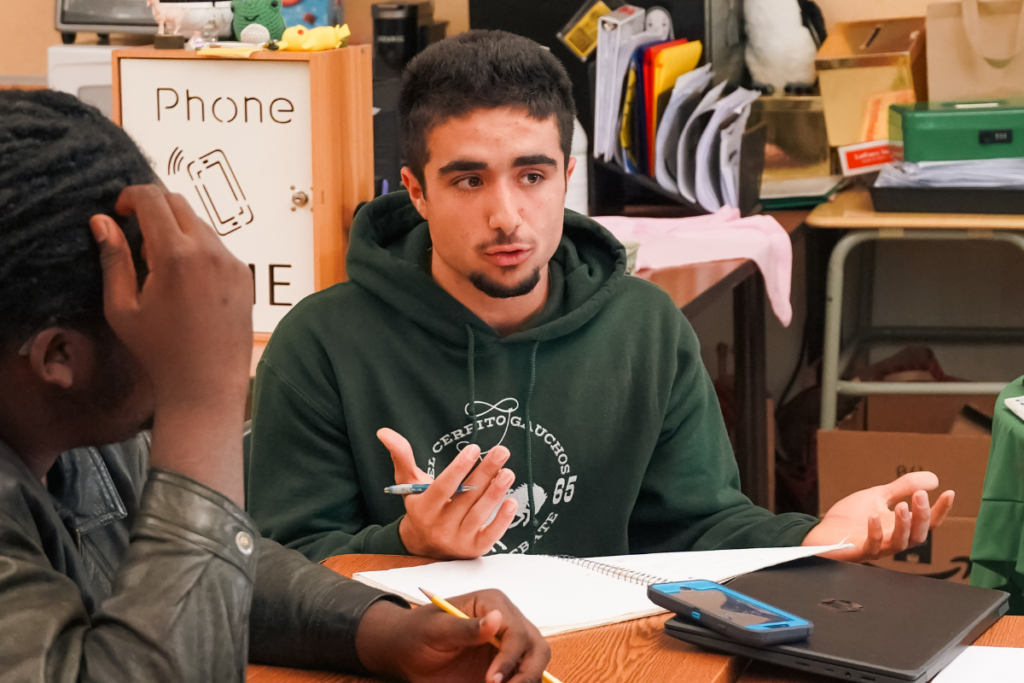
Communication is a struggle that is worth it because it is a durable skill that can take you anywhere. What all of our participants have in common is that they believe it is important to try. According to one of our Junior Board of Directors, 16-year old Ezra, “The Practice Space is all about decision making and the power of people to build community, which AI can’t replace. Leading is a form of exercising your own autonomy. It’s easy to escape, but we need to learn to make informed decisions, stand by them, and communicate them in a way that people can understand.” What we don’t want is a world where only a few people have control over the information used for decision-making and a world where the next generation doesn’t get to understand the value of productive struggle. When AI is always available to everyone, incentivized by an economy centered on convenience and speed, it will get harder to decide not to use AI or even learn how to think critically and know how to struggle in the first place.

ASK YOURSELF BETTER QUESTIONS
As a future leader, you cannot allow your muscle for productive struggle to waste away. Instead, you need to be able to decide for yourself when the struggle is worth it. A world with AI means a daily evaluation of whether and how you use AI for help, if at all. As researchers Shaw & Nave remind us, there is a difference between cognitive offloading and cognitive surrender – our intentionality about when and how we use AI is how we can navigate this distinction. Doing so requires us to ask ourselves thoughtful questions.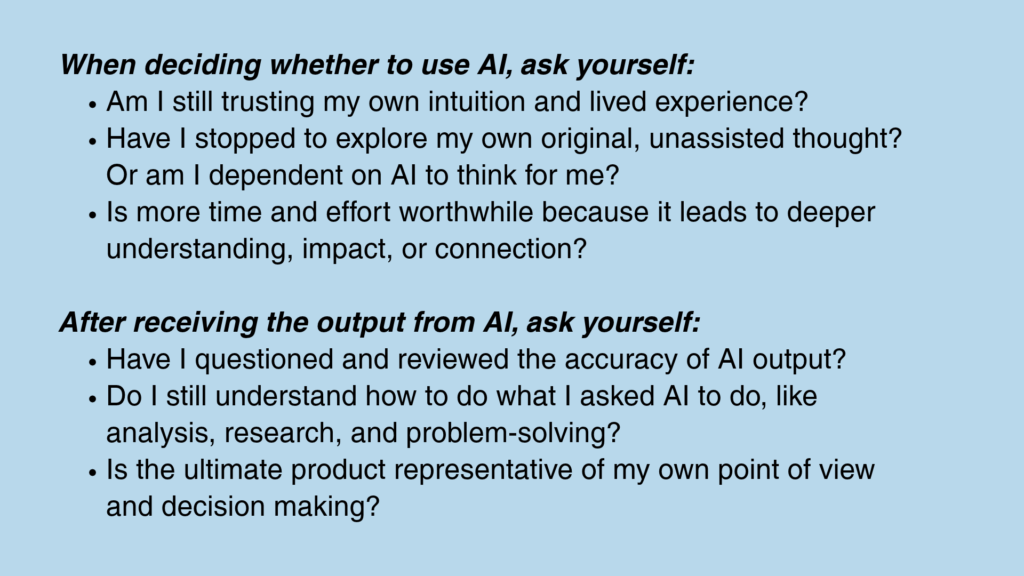

BE YOUR OWN LEADER
The world continues to change, as does the role of AI in leadership. What remains true is that future leaders need safe, welcoming spaces to productively struggle and practice using their voice. Our coaching and capacity-building contributes to the larger ecosystem of organizations that are engaging in productive struggle in service of positive change. The leaders we work alongside are empathetic and ethical and they have a sense of purpose and commitment. Leaders who care about people often also have high standards for themselves and care about what people think, which can sometimes lead to doubting their voice. As a trusted partner for authentic communication, we make sure that people are ready to show up for their communities and have confidence and trust in their voices, regardless of whether they have the option to use AI. When they use AI, they do so intentionally, and they combine AI-enabled learning with learning from friends, colleagues, and trusted experts. They still rely on their own unique lived experience, judgment, and ethics. They ask themselves questions to ensure that they are still the ones leading and making decisions. Investing in the struggle means learning how to become a more effective, productive, and ultimately, a more human leader.
Trust yourself. Choose to do hard things.
Sincerely,
The Practice Space

Get notified of upcoming events and classes
Subscribe to our email list